CYBER, COUNTRY, AND CONTEST
PREPARING FOR THE STORM
Threat actors will soon leverage fleets of AI agents in massive attacks across the United States. Knowing this, we can prepare for these events. We can identify what assets across the homeland are critical to sustain our way of life. We can determine what is within the reach of offensive agents today and predict what may soon be within their grasp tomorrow. We can harden these assets and prepare them for contest.
If we work with urgency to coordinate across private sector firms and government agencies, we can develop channels of observability that will alert us to imminent and ongoing attacks. We can develop counter-technologies to take our adversaries by surprise: by denying their effect on the target, soaking up their resources into fake assets, and turning their own technology against them.
To do this, we must begin to develop a shared language and grammar for cyberattacks.
Across the country, our American culture predisposes us to a fondness for weapons and bearing arms. So great is our love of weapons that we have trouble keeping them out of elementary schools. Despite our political confusion on school shootings — I recognize they are a reflection of our national character. But in our weakness so too do we see reflection of our strength. Let me illustrate.
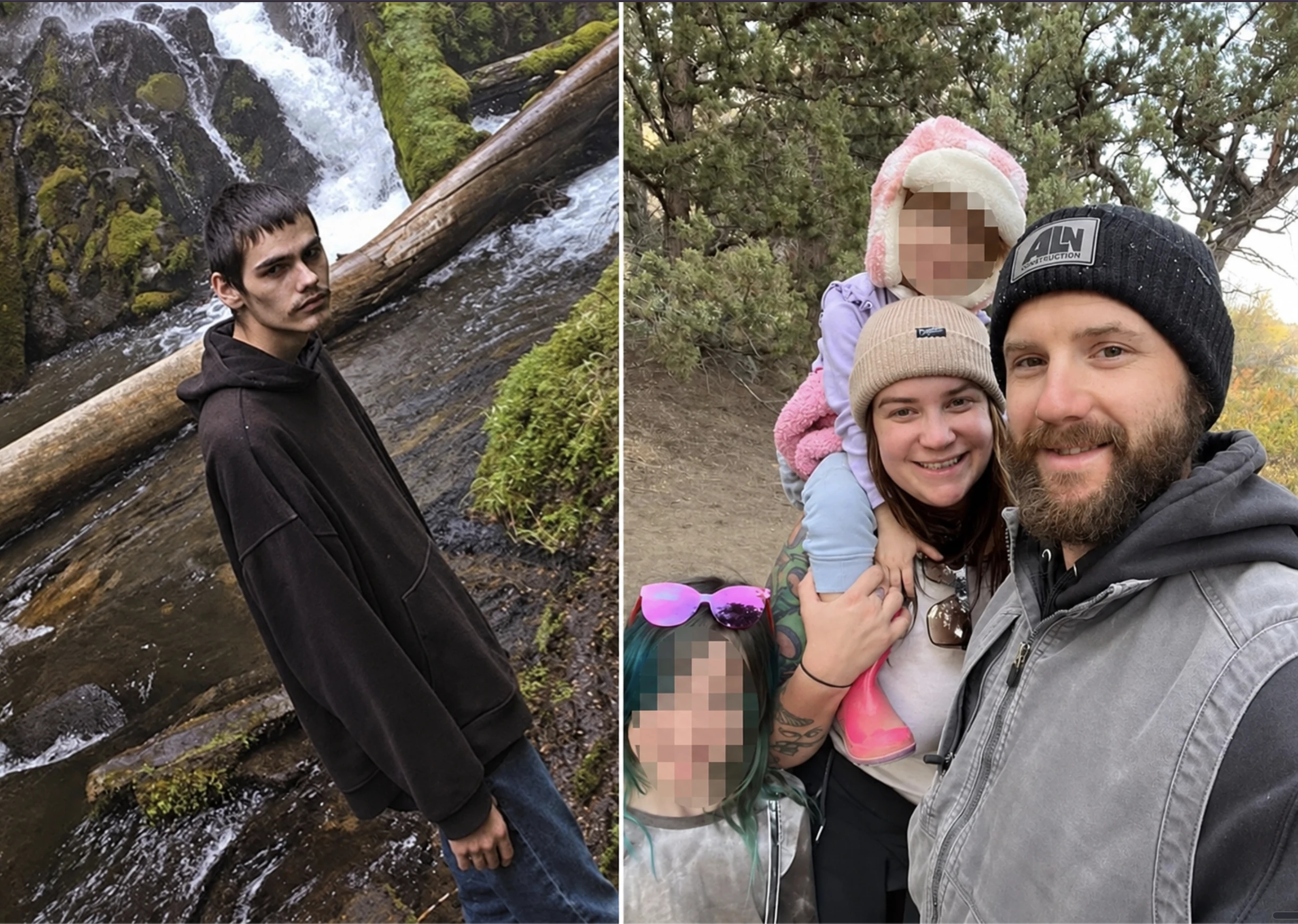
Last week a young man in Oregon walked to an elementary school with a shotgun during picture day. He walked to a side door with glass panes and blasted through. He entered a special needs classroom and began to kill children. Outside the school was a carpenter who by chance was driving past the school of his daughters. The carpenter was armed. He witnessed the attacker shoot through the doors. The carpenter followed him in and took the other man’s life. Because of his actions this rampage was ended in the first classroom rather than the fifth.
Here I see our national character. Here I see our nation that grapples with its relationship to weapons, to defense, to violence. And here I see us on the precipice of a major technological change. There is a new class of weapons that is about to be unleashed on the American people. These weapons will be wielded by nation states, by terrorist cells, by criminal groups, and by lone wolves. As it stands we are not ready for this event. The weapons I am referring to are increasingly capable AI systems.
It is possible for us to counter these weapons. It is possible to improve our understanding of how they act, what attracts them, how they observe and orientate themselves to an environment — where and why they fail. Through coordinated action, national mobilization, and the force of applied research in public-private partnerships — we can better position ourselves not only to weather the coming storm — but to prosper from it. Likewise, it is possible to arm Americans with technology that allows for self-defense, that enables them to take action during attacks on their communities, their companies, and, by extension, their country.
The central notion I believe deserves our focus is reducing technological surprise.
What this means is we want to prepare our critical and commercial infrastructure for the incoming swarms of autonomous cyber attacks. We want to develop new methods of observability to warn us of incoming attacks and respond to ongoing harm — technology capable of rendering an AI agent incoherent as it carries out an offensive attack — and canary payloads that when exfiltrated damage the attacker's operation.
Where do we begin?
CYBERSPACE UNDERPINS OUR WAY OF LIFE
There are critical functions needed to sustain our way of life in this country. The compromise of these functions, or their sustained denial and degradation, will affect your day-to-day experience as an American. They enable you to fuel your car, have electricity in your house, take out cash from an ATM, connect to the internet, and, in an emergency, call for help.
In our research institutions, they are what allow us to keep our samples frozen in liquid nitrogen, to trust our collaborators, instruments, and data stores. In our healthcare institutions, they are what allow us to tend to the sick, to effectively triage the wounded in cases of mass harm, and to prevent undue loss of life. In our security institutions, they give us faithful readouts from early warning systems, be that through channels of human intelligence that forewarn us of adversary behavior, or through technical infrastructure that serves our common defense, such as radar and wastewater surveillance.
All of the above rely on functioning information systems. They all involve electronics, computing, and the transmission, transformation, and interpretation of information. They are how we make sense of the world at a distance. You can imagine a nation’s cyber infrastructure serving as its sense organs, the eyes and ears through which it orients itself to what is happening. You can imagine, then, the opportunity for an attacker. To undermine a nation’s ability to respond, to curtail its ability to achieve political objectives, to degrade its ability to perceive.
Thus, my chief research concern as of late rides along these lines, the weaponization of science and technology. How can AI be used to cause massive loss of life by combining its advanced capabilities in cyber, chemical, and biological domains? If the goal is to undermine national security, to cause terror, or to kill many people, how much of that can threat actors accomplish without ever leaving their computers? I do not know the answers to these questions, but I do seek them. In the pursuit of these ends, I have begun to surround myself with subject-matter experts and bright, questioning colleagues. But to elicit knowledge from these peers, you must learn a new language.
BASIC GRAMMAR OF CYBER
ACCESS, POSITION, FIRE, RESULT & EFFECTS
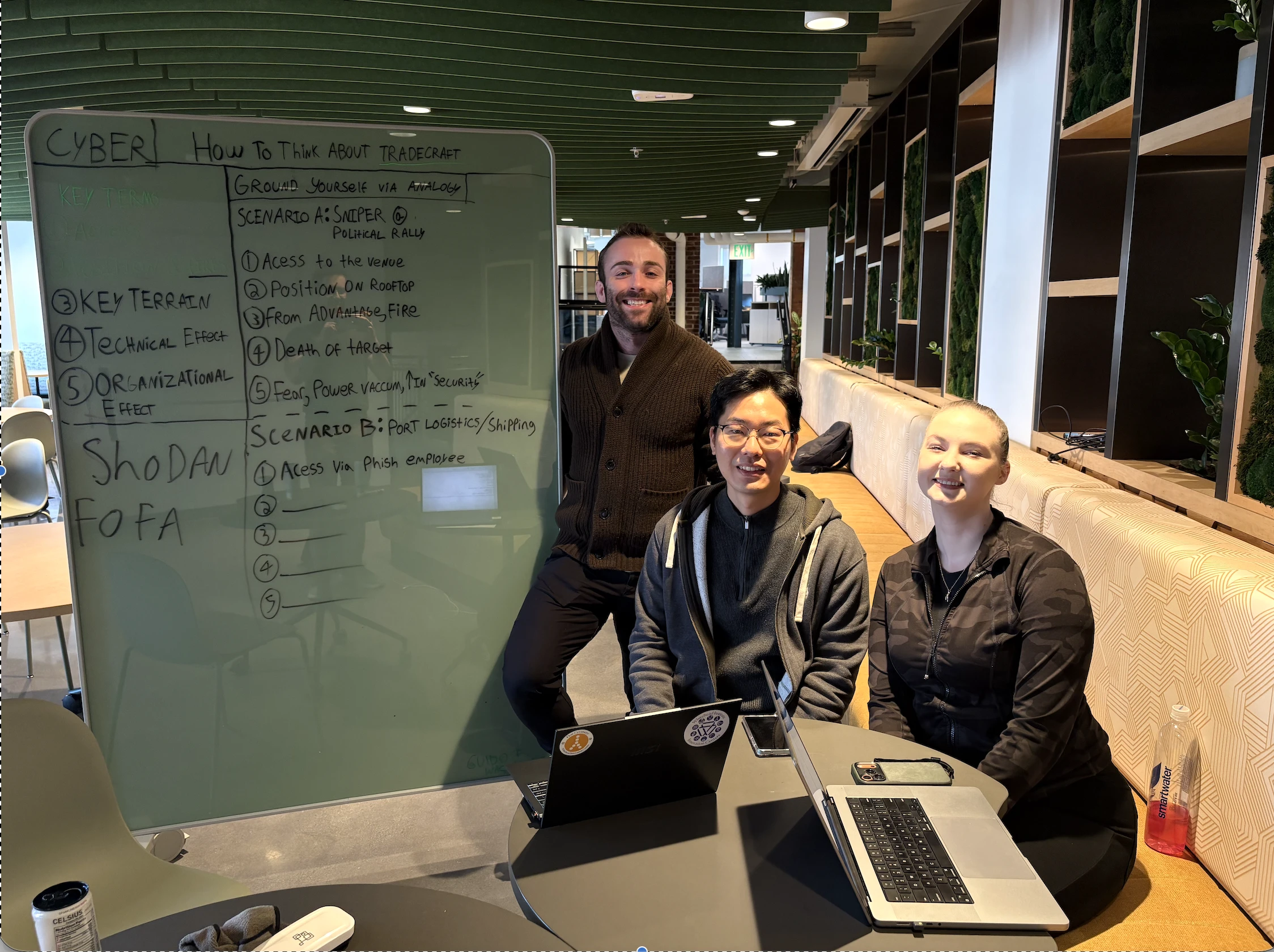
We can speak of the kill chain of a cyber force by first grounding ourselves in this parallel.
A sniper arrives at the venue (initial access). He maneuvers to an advantageous position (a rooftop). From this vantage point, he can see higher-value targets and take aim. He fires his weapon. A person is killed. The death of that person can create an operational consequence, depending on who the victim is. The firing of the weapon reveals to the defender that there is an active and local adversary. If the shooter does not move, they will be found, and their access will be ended.
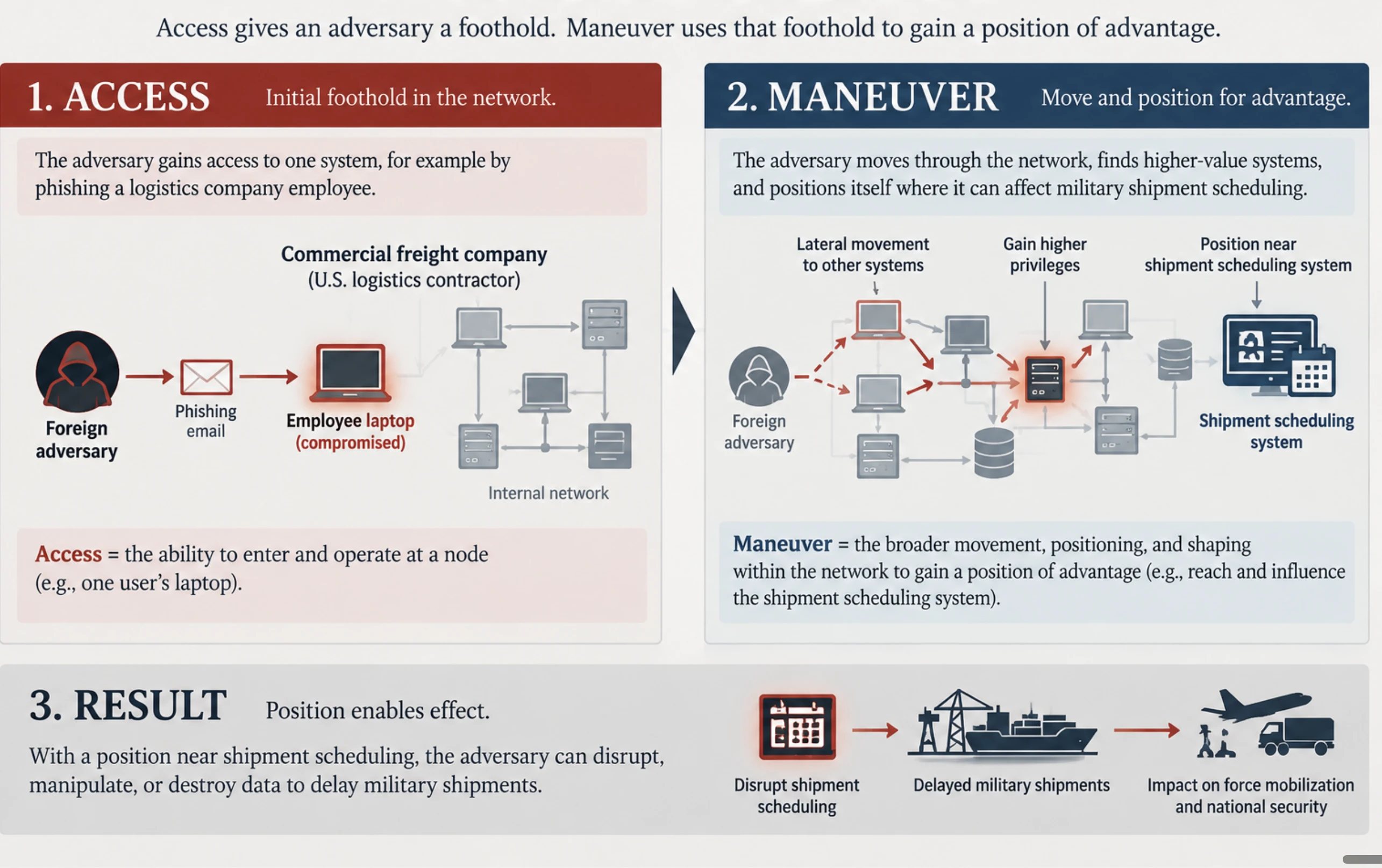
An agent sends a phishing email to a tired corporate employee and succeeds, compromising their credentials or computer (initial access). From this position of access, the agent maneuvers into an advantageous position further into the network (escalating their privileges to system administrator). From this vantage point, the agent can see higher-value targets (business function) and take aim. On command, the agent takes an offensive action to degrade or disrupt that business function. The effect will have consequences for the organization (such as reduced trust in information technology, increased processing time, and manual verification of orders). That offensive action can alert the defender to the agent’s presence. The agent has a limited window for further action before their access is ended.
At this basic level, we see then that our shared grammar for an attack is
INITIAL ACCESS
MANEUVER INTO POSITION
FIRE
TECHNICAL RESULT
OPERATIONAL EFFECT
There is much to learn. And there is much great work to do.
warmly,
austin